01The Ratio First
A frittata asks almost nothing of you. It doesn't care if you planned it. It cares only that you've got eggs, something in the fridge, and an oven-safe pan — and that you don't rush it.
Six eggs is the right number for a 20–24 cm pan serving two well or four as a light supper. Beat them properly — a minute at least, until the yolks and whites are completely unified and the mixture looks a little frothy. Season aggressively with salt: more than feels polite, because the eggs will absorb and mellow it. Then add your dairy. A generous tablespoon of crème fraîche, soured cream, or full-fat yoghurt, beaten in. This is what softens the set, keeping the interior just-custardy rather than bouncy or dry. No cream required — the fat content of any of those three does the job, and the slight tang isn't unwelcome.
That's your base. Everything else is negotiation.
A generous tablespoon of crème fraîche, soured cream, or full-fat yoghurt, beaten in.
02Build It in the Pan
The filling goes in first, and it must be ready to eat before the egg touches it. Raw onion will never fully cook once the egg is in; wet vegetables — courgette, mushrooms, greens — must be driven of their moisture in a hot pan or they'll waterlog the whole thing. So: start in a 26 cm ovenproof frying pan (a little larger than your egg volume needs, to give room) over a medium-high flame. Add whatever you're using — sliced cooked potato and rosemary, caramelised onion and blue cheese, roasted peppers and chorizo, wilted spinach and feta, leftover roasted squash and a handful of grated pecorino. Cook aromatics until soft, add anything wet, cook until the pan is dry again. Taste it. The filling should be nicely seasoned on its own.
Turn the heat down to medium-low. Add a knob of butter, let it foam, then pour the egg mixture over the filling. Don't stir. Tilt the pan to let the egg settle into the gaps. Now comes the part that separates a good frittata from a rubbery one: patience at low heat. Let it sit, undisturbed, for four to five minutes, until the edges are set and pulling away slightly from the pan, but the centre is still visibly wobbly — liquid, almost. A thin spatula drawn around the edge tells you where you are.
Slide it under a hot grill (broiler) for two to three minutes, watching constantly, until the surface is just set and lightly golden. You're not browning it into an omelette; you're just closing the top.
| Figure | What it's for |
|---|---|
| 6 eggs | base quantity for a 20–24 cm pan, serves 2–4 |
| 4–5 minutes | stovetop cooking time before the grill |
| 5 minutes | resting time after the grill; essential for a clean cut |
| 2–3 minutes | grill/broiler time to set the surface |
03Rest, Then Cut
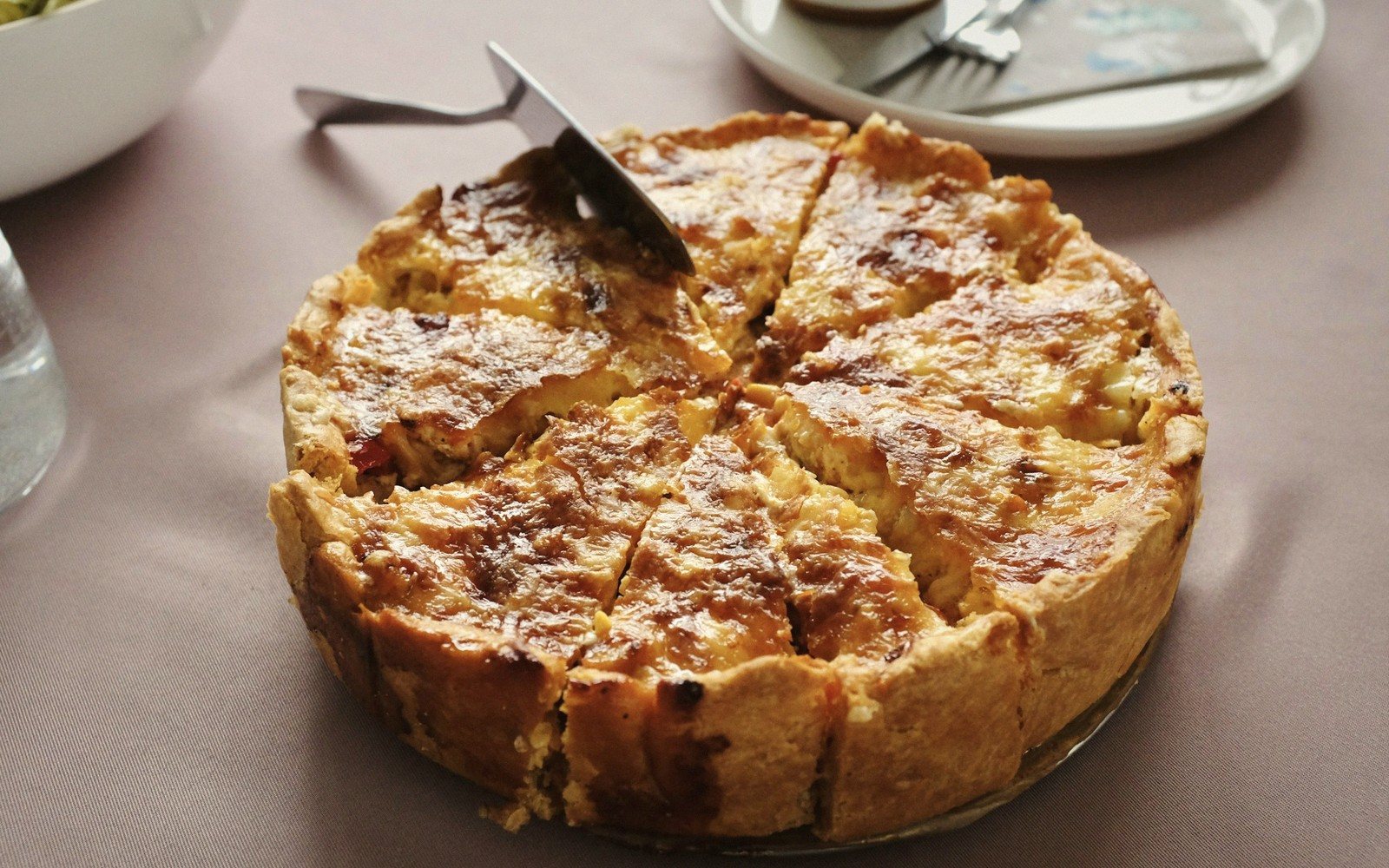
This is non-negotiable: rest the frittata in the pan for five minutes off any heat before you cut into it. The residual warmth in the pan and the egg itself carries the cooking; the centre finishes quietly. Cut too soon and you'll have liquid running where you wanted a clean slice. Wait, and it holds perfectly.
Slide onto a board or serve straight from the pan. A sharp, undressed salad — leaves, something acidic — cuts through the richness. The frittata itself is as good at room temperature as it is hot, which means leftovers are tomorrow's desk lunch without any argument.
The formula doesn't change. The filling can be almost anything. That's the whole point.