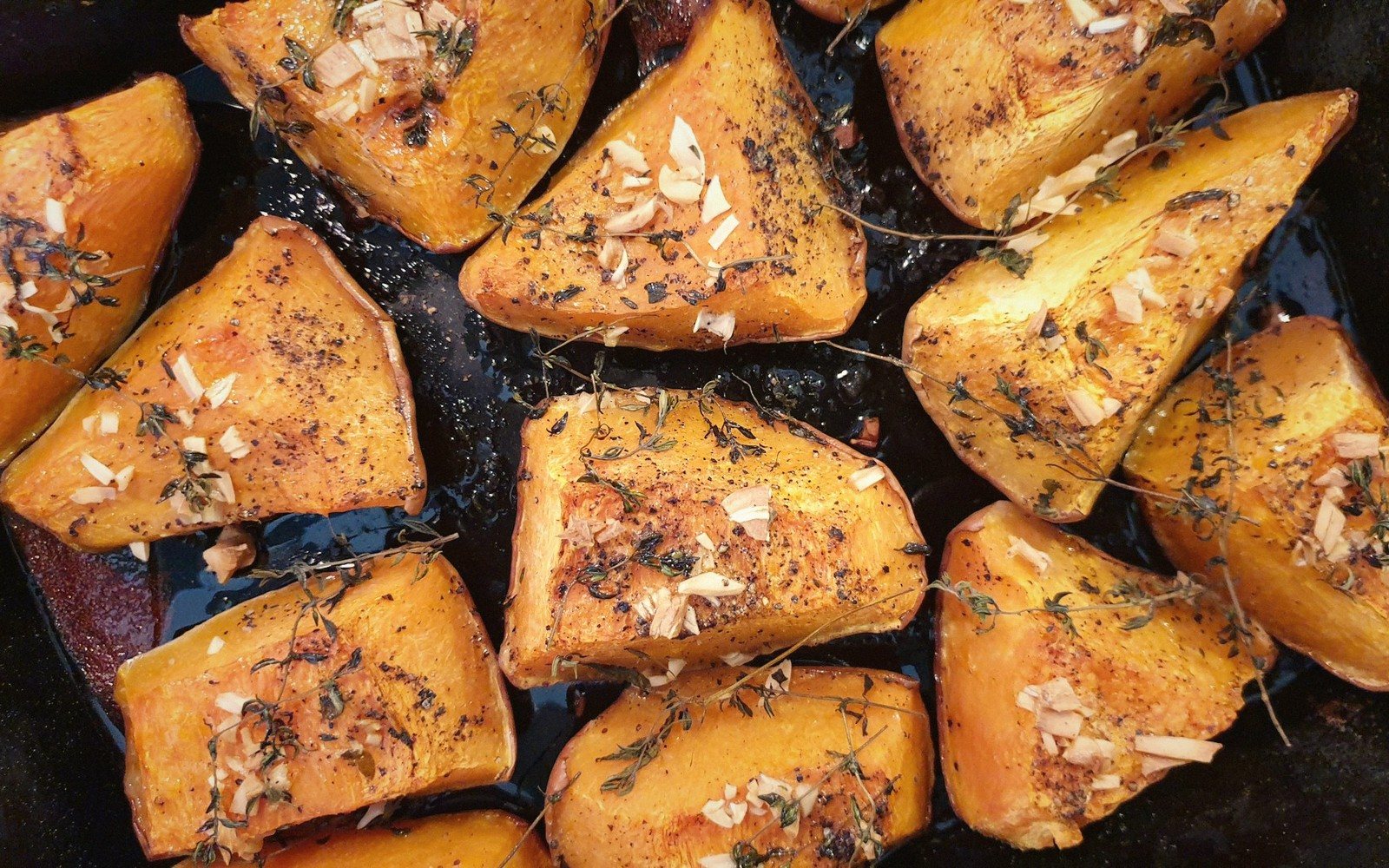
01Wedges, soup, caramelised edges — how autumn squash earns its place on the weeknight table.
Chunks are better when you want them to hold up in a grain bowl or pulse salad.
02Start With Heat
Squash doesn't reward timidity. It's a dense, water-logged vegetable that needs a genuinely hot oven — 210°C or above — and enough space on the tray to roast rather than steam. Crowd it, and you get soft, pallid chunks; give it room and high heat, and the cut edges caramelise into something almost jammy, the sugars browning against the metal.
Butternut is the workhorse: easy to peel, consistent in texture, reliably sweet. But it's worth knowing the others. Crown Prince has a grey-green skin and a dense, almost nutty flesh that holds its shape well in soups. Delica — the flat, dark-ribbed pumpkin common in Italian cooking — is less watery than butternut and roasts beautifully with very little fuss. Kabocha is a Japanese variety, thicker-skinned and drier still, with a chestnut-like richness that makes it arguably the best squash for eating straight off the tray. Most can be left unpeeled if the skin is thin enough; it becomes tender in the oven, and it saves considerable effort.
The cut matters more than people realise. Thin wedges — two centimetres or so — get maximum surface area against the hot pan and colour quickly. Chunks are better when you want them to hold up in a grain bowl or pulse salad. For soup, you can roast halved squash cut-side down on an oiled tray, which concentrates the flavour before it goes anywhere near a blender.
03On the Tray
For wedges, the method is simple: a good pour of oil (enough to coat properly — squash absorbs it), salt early, and whatever seasoning suits the night. Chilli flakes and cumin lean warm and North African; a little smoked paprika and a scrape of harissa at the end takes it somewhere different. A few unpeeled garlic cloves roasted alongside are ready at the same time and slip straight into a dressing, a yoghurt sauce, or the pan itself. Fresh sage laid under the squash for the last ten minutes turns crisp and fragrant; thyme works at the same intensity.
One technique worth adding to the rotation: coat the wedges in a thin paste of miso, a little oil, and a splash of rice vinegar before they go into the oven. The miso darkens and intensifies as it roasts, giving the edges a deep, savoury lacquer that plays well against the natural sweetness of the flesh. It takes thirty seconds more effort and pays back considerably.
04Soup Is Not an Afterthought
A roasted squash soup is a different thing entirely from one made by boiling. Boiled squash soup is fine — inoffensive, a little thin in character. Roasted squash soup has depth because the Maillard reaction has already done its work before any liquid arrives. Roast your squash, roast an onion or two alongside it, then tip everything into a pot with stock, a tin of coconut milk if you like, and blend. The colour is deeper, the flavour more rounded, the whole thing more worth making.
Season assertively. Squash is very sweet and needs salt and acid to balance it — a squeeze of lime, a splash of sherry vinegar, or even just more salt than you think reasonable. Stir in a spoonful of good chilli or spice paste at the end, or fry mustard seeds in butter and pour the sizzling, spitting oil directly over the bowl. Either approach shakes it out of blandness.
| Figure | What it's for |
|---|---|
| 210°C | minimum recommended roasting temperature for squash |
| 2 cm | ideal wedge thickness for maximum caramelisation |
| 4 days | refrigerator life of roasted squash |
05One More Move
Leftover roasted squash is genuinely useful. Mash it roughly and fold it through pasta with brown butter and sage, or pile it onto toast with crumbled cheese and a drizzle of honey. It keeps in the fridge for four days and improves with a little time — the flavour deepens as it sits. Roast a full tray at the weekend, and squash appears in three dinners without thinking about it twice.
The oven is already hot. Use it.